
Brazilian Jiu Jitsu over 40

Train for decades to come. Not just your next roll.

Brazilian Jiu Jitsu can be one of the most rewarding sports to practise as an adult.
It is also physically demanding.

Training places significant demands on the neck, shoulders, hands, hips, knees, spine, cardiovascular system, and overall recovery capacity.

As we get older, continuing to train well often requires a more intelligent approach.

Brazilian Jiu Jitsu After 40 at Delray Care is designed for adult practitioners who want to stay on the mats, improve their physical capacity, recover from setbacks, and continue training for years to come.

Jiu Jitsu Changes as We Get Older

The goal does not have to be to train less.

But the way we prepare, recover, and manage our body may need to evolve.

In your 40s, 50s, and beyond, factors such as recovery, training volume, mobility, strength, sleep, conditioning, and load management can have an increasingly important role in how consistently you are able to train.

Trying to train exactly the same way you did years ago is not always the best strategy.
A smarter approach is to build the physical qualities that support the demands of Jiu Jitsu while managing training in a way that allows you to keep showing up.

Built Around the Demands of Brazilian Jiu Jitsu

This is not generic fitness advice.

Brazilian Jiu Jitsu places unique demands on the body.

Training may require repeated gripping, pulling, pushing, rotation, bracing, hip movement, knee loading, neck strength, shoulder stability, and the ability to produce effort while fatigued.

Our approach considers the physical qualities that matter specifically for Jiu Jitsu, including:

  • Mobility
  • Strength
  • Grip capacity
  • Neck resilience
  • Shoulder strength and stability
  • Core strength and control
  • Hip mobility and strength
  • Knee capacity
  • Conditioning
  • Recovery
  • Training load management
  • Movement efficiency
  • Long-term physical resilience

The goal is to help build a body that is better prepared for the demands of training.

A Different Approach to Staying on the Mats

Many practitioners wait until something goes wrong before thinking seriously about their body.

But long-term training requires more than reacting to injuries.
It requires building capacity.
That means identifying areas that may limit performance, understanding the demands being placed on the body, and improving strength, mobility, conditioning, and recovery before they become bigger problems.

For some practitioners, the goal may be returning to training after an injury.

For others, it may be improving performance.

For others, it may simply be training consistently without feeling like every hard session takes several days to recover from.

The approach depends on the individual.

Clinical Experience Meets Firsthand Jiu Jitsu Experience

Delray Care brings together more than 26 years of orthopedic and performance experience with firsthand experience of Brazilian Jiu Jitsu.

As a physical therapist and Brazilian Jiu Jitsu black belt, I understand the sport from both sides.

I understand the biomechanics, physical demands, recovery considerations, and performance requirements from a clinical perspective.

But I also understand what it feels like to train.

I understand why people keep coming back to the mats.

I understand the frustration of being unable to train.

And I understand why simply being told to stop doing Jiu Jitsu is rarely the answer someone wants to hear.

Returning to the Mats at 56

I started Brazilian Jiu Jitsu in my 40s.

After an eight-year layoff, I returned to the mats at age 56.

That experience taught me a great deal about what it means to rebuild capacity later in life.

Coming back required more than simply remembering technique.

It meant rebuilding strength, conditioning, mobility, timing, and confidence.

It also meant learning how to manage ego, recovery, training volume, and expectations differently.

The body you return with may not be the same body you trained with years ago.

That does not mean you cannot train.

It means the approach needs to be smarter.

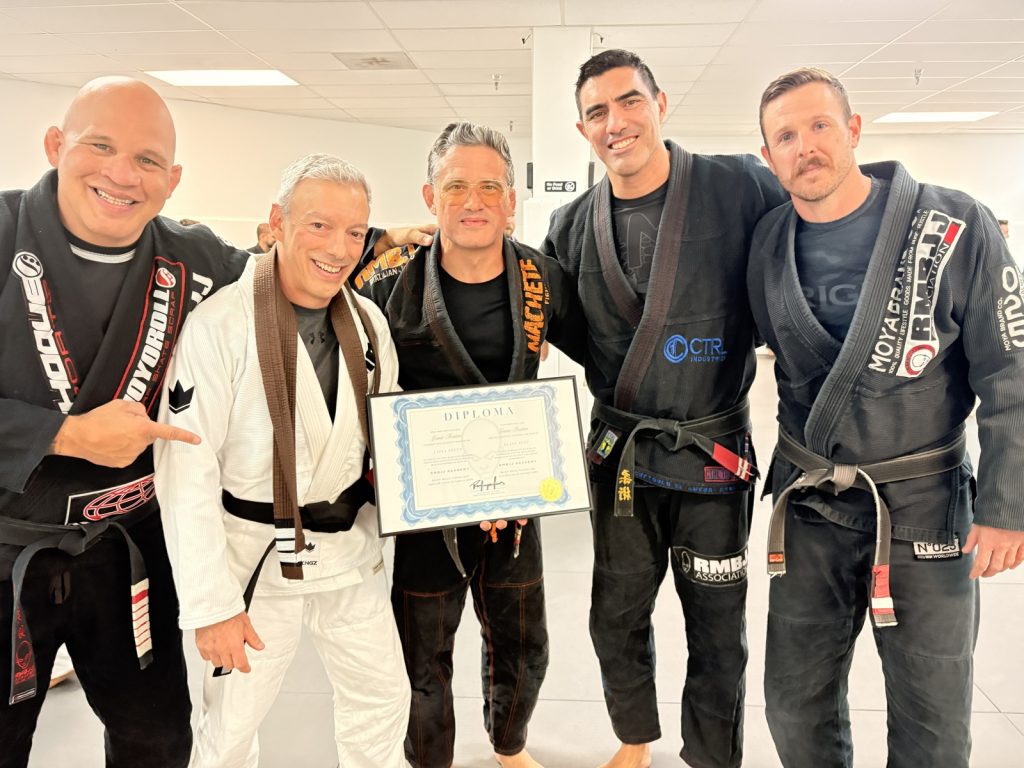
Lou Fratto receiving his Brazilian Jiu Jitsu black belt alongside his coaches.
I began Brazilian Jiu-Jitsu at 41, returned after an eight-year layoff, and earned my black belt in 2026. It is never too late to return, improve, or pursue a difficult goal.

Managing Ego, Recovery, and Training Load

One of the biggest challenges for experienced adult practitioners is that the mind often remembers what the body used to be able to do.

It is easy to push too hard, roll too often, or ignore the signals that recovery is falling behind.
A sustainable approach to Jiu Jitsu requires balancing ambition with intelligent training.

That may mean adjusting training frequency, building strength outside the gym, improving mobility, developing conditioning, managing hard rounds more strategically, and recognizing when recovery needs more attention.

The aim is not to make training easier.

The aim is to make training more sustainable.

More Than Traditional Physical Therapy

Traditional physical therapy often focuses on getting someone back to basic function after an injury.

For a Brazilian Jiu Jitsu practitioner, basic function may not be enough.

You may need to grip.

Bridge.

Shrimp.

Rotate.

Frame.

Pull.

Push.

Scramble.

Control another person’s body-weight.

Produce force while tired.

And repeat all of that several times per week.

Returning to daily life and returning to Jiu Jitsu are not the same thing.

That is why the approach at Delray Care considers the actual demands of the sport and the physical capacity required to train successfully.

For Practitioners Who Want to Keep Training

Brazilian Jiu Jitsu After 40 may be appropriate for practitioners who want to:

  • Return to training after an injury or extended break
  • Improve strength and physical resilience
  • Address mobility restrictions
  • Improve conditioning
  • Build greater neck and shoulder capacity
  • Improve hip and knee strength
  • Manage recurring physical setbacks
  • Recover more effectively between sessions
  • Prepare the body for increased training volume
  • Continue training well into their 50s, 60s, and beyond

You do not need to be a competitor.

You simply need to care about continuing to train.

The Goal Is Longevity on the Mats

Jiu Jitsu is a long-term pursuit.

For many people, the goal is not one competition, one belt, or one particularly good training session.

The goal is to still be training years from now.

That requires thinking beyond the next roll.

It requires building strength, capacity, recovery habits, and training strategies that support the long game.

If staying on the mats matters to you, let us help you build a body that is better prepared to do exactly that.

Take A Look At What People Like You Are Saying About

Delray Care Physical Therapy

Lou Fratto

MS, PT, MTC

Lou Fratto has more than 27 years of experience helping people overcome pain, restore movement, and build the strength and confidence to remain active throughout their lives. His clinical expertise includes orthopedic and sports injuries, joint replacements, spinal conditions, balance problems, and rehabilitation following surgery. Lou combines advanced manual therapy, corrective exercise, and personalized movement strategies to address the source of each patient’s limitations and create meaningful, lasting results.

Lou believes that aging is inevitable, but losing the ability to participate fully in life does not have to be. His life’s mission is to help people quickly return to, stay involved in, and ultimately excel at their favorite activities. Whether that means returning to the tennis court, traveling confidently, competing in a sport, playing with grandchildren, or simply moving through life without fear, Lou wants every patient to feel capable, resilient, and excited about what comes next.

Lou graduated summa cum laude from The University of Texas at Dallas with a Bachelor of Arts in Economics and Finance. He earned his Master of Science in Physical Therapy from Texas Woman’s University and completed advanced manual therapy certification through the University of St. Augustine for Health Sciences.


After working in two corporate health care organizations, Lou opened a private physical therapy practice in Palm Beach Gardens in 2005. In 2016, he founded Delray Care Physical Therapy in his hometown of Delray Beach. He created the practice to provide highly personalized care in an environment where patients feel heard, supported, and confident in their ability to recover and thrive.

Lou’s commitment to clinical excellence has taken him across the country to study with respected leaders in physical therapy, including Greg and Vicky Johnson, Stanley Paris, and Tim Crunk. He continues to expand his knowledge in movement, performance, recovery, and longevity so he can help people not only feel better, but become more capable than they were before. This philosophy also inspired his book, Thrive: A Physical Therapist’s Guide to Longevity, which is available on Amazon.

Outside the clinic, Lou enjoys spending time with his wife and daughter, family, friends, and their three pets. He also enjoys traveling, dining out, exercising, participating in adventure races, and practicing Brazilian jiu jitsu, in which he holds a black belt. His own commitment to remaining active and continually challenging himself reflects the same philosophy he shares with his patients every day.

Susan Fratto

Administrator and Director of Customer Experience

Susan Fratto isn’t just our administrator; she’s the heart and soul of our establishment, orchestrating every interaction with unparalleled friendliness, grace, and enthusiasm. As our administrator and director of customer experience, Susan is the embodiment of warmth and loving energy, treating everyone as a cherished family member. Working in the service industry for over 35 years has allowed her to master the art of first-class service, ensuring that every moment with us exceeds your expectations. While our experts tirelessly work to quickly return you to your favorite activities, Susan elevates your journey to healing with a touch of elegance and care, making every visit an unforgettable encounter.