

If your foot or ankle is bothering you, here’s the first thing you need to understand:
It’s not random.
Foot and ankle pain doesn’t just “show up.” It builds. It develops. It responds to load, stress, habits, footwear, strength levels, and movement patterns.
And most importantly?
It can improve.
But only if you address the root — not just the symptoms.
Let’s break this down the right way.
Your Feet Are the Foundation

You have 26 bones in each foot.
Dozens of joints.
Layers of ligaments.
Small intrinsic muscles.
Powerful tendons like the Achilles.
Your foot isn’t just a platform — it’s a dynamic structure designed to:
- Absorb force
- Adapt to uneven surfaces
- Stabilize your body
- Propel you forward
Your ankle connects that entire system to the rest of your body.
When this system isn’t functioning well, everything above it compensates.
Knees.
Hips.
Low back.
So when your foot hurts, the solution isn’t always at the exact spot of pain.
It’s in how the system is working.
Why Foot and Ankle Pain Happens
Let’s keep this simple.
Foot and ankle pain usually comes from one of four issues:
- Too much load too fast
- Not enough strength to handle load
- Poor mobility or stiffness
- Previous injury that was never fully rehabbed
That’s it.
You increased walking.
You started running again.
You changed shoes.
You stood more at work.
Load increased. Capacity didn’t.
Pain is your body’s way of saying, “I’m not prepared for this.”
It’s not weakness.
It’s a capacity issue.
The Ankle Mobility Problem
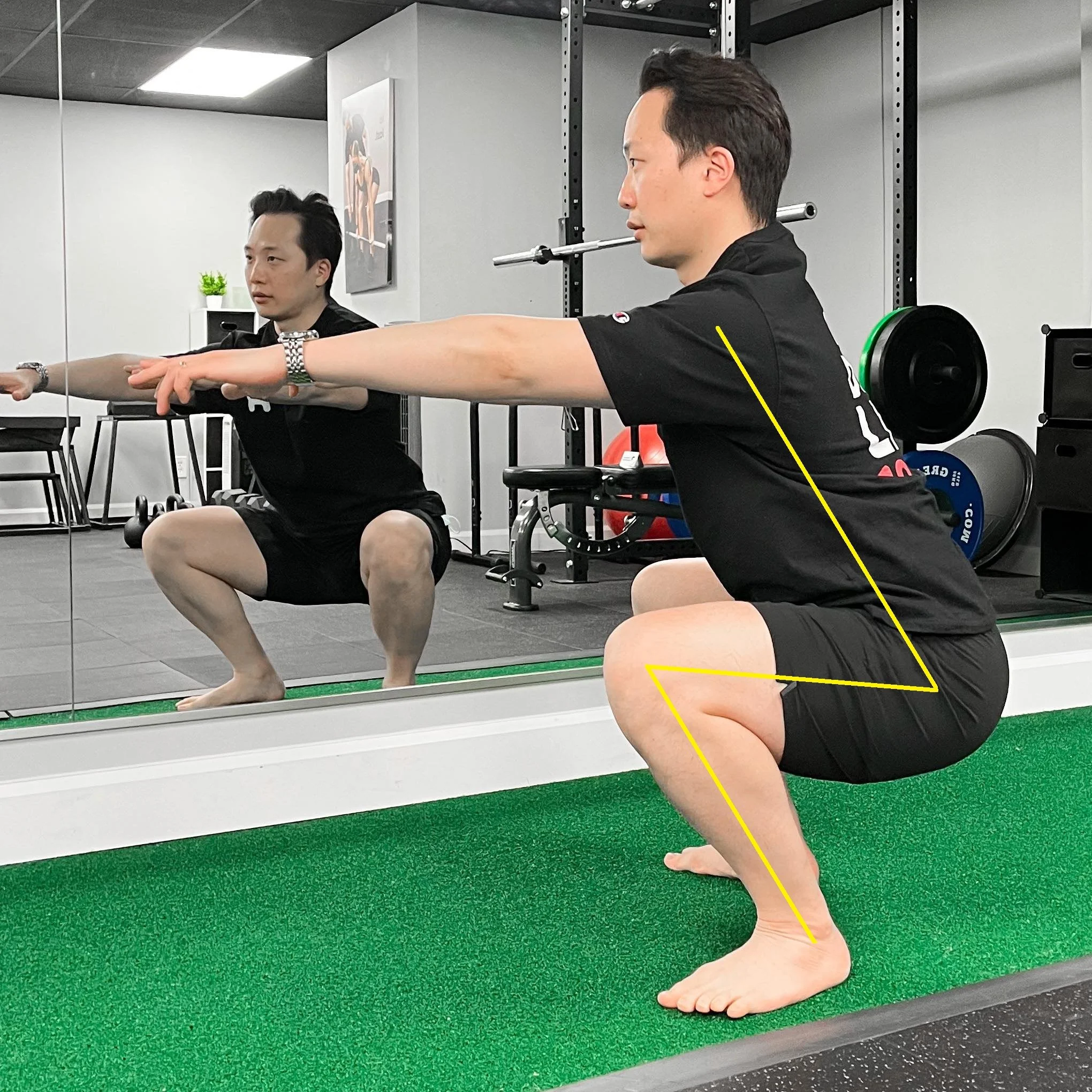
Limited ankle mobility — especially dorsiflexion (bringing the knee over the toes) — is one of the most common contributors to foot and ankle pain.
If your ankle doesn’t move:
- Your arch collapses more
- Your Achilles takes extra stress
- Your knee compensates
- Your foot absorbs more force than it should
And then you wonder why it’s irritated.
Simple mobility drills can make a massive difference:
- Knee-to-wall ankle drives
- Eccentric calf stretches
- Slow controlled heel drops
Mobility isn’t about forcing range.
It’s about reclaiming it gradually.
Strength: The Missing Piece
Here’s where most people fall short.
They stretch.
They ice.
They roll their foot on a ball.
But they don’t build strength.
The foot has intrinsic muscles that support the arch.
The ankle has stabilizers that prevent rolling.
The calf complex controls load absorption.
If these muscles aren’t strong, the joint takes the stress.
Foundational strength work includes:
- Double-leg → single-leg calf raises
- Short foot (arch activation) drills
- Resistance band inversion/eversion
- Controlled step-downs
- Isometric calf holds
You don’t need fancy equipment.
You need progression.
Previous Ankle Sprains: The Lingering Issue
If you’ve sprained your ankle before, listen carefully:
Rest is not rehab.
Most ankle sprains get swelling down… but never restore:
- Full mobility
- Strength symmetry
- Balance control
- Reaction timing
That leaves lingering instability.
Instability increases reinjury risk.
And reinjury increases sensitivity.
Proper rehab includes:
- Balance training
- Single-leg strength
- Lateral control drills
- Gradual reintroduction to dynamic movement
If your ankle still feels “off” months later, it probably never finished rehab.
Impact Isn’t the Enemy

Running and jumping often get blamed for foot pain.
But impact isn’t the problem.
Unprepared impact is.
Your tissues adapt to load — if you introduce it gradually.
If you go from low activity to high mileage, irritation follows.
If you build progressively:
- Walking → brisk walking
- Brisk walking → intervals
- Intervals → running
Your foot adapts.
Avoiding impact forever reduces tolerance.
Controlled exposure builds resilience.
Footwear: Support vs. Dependency
Shoes matter.
But they aren’t magic.
Overly cushioned, unstable shoes can reduce foot muscle activation.
On the other hand, transitioning too quickly to minimalist shoes can overload tissues.
The key is progression.
If you change footwear:
- Reduce activity volume
- Gradually build tolerance
- Monitor symptoms
Shoes are tools.
Strength is the long-term solution.
Load Management: The Big Lever
Most flare-ups follow the same pattern:
Low baseline activity → sudden spike.
Long walk on vacation.
Yard work marathon.
Returning to the gym aggressively.
The fix?
Build baseline capacity.
Two to three strength sessions per week.
Gradual volume increases.
Monitor weekly load.
Your foot doesn’t need perfection.
It needs predictability.
The Chain Above Matters
Your foot doesn’t work alone.
Weak hips can change foot mechanics.
Poor glute control can increase ankle stress.
Limited hip mobility can alter loading patterns.
That’s why a full assessment matters.
Treating only the foot misses the system.
Strong hips support stable ankles.
What Recovery Should Feel Like
It should feel:
- Challenging but controlled
- Progressive
- Measurable
- Structured
You should see improvements in:
- Single-leg balance time
- Calf raise endurance
- Step-down control
- Walking tolerance
If you’re guessing, you’re probably stalling.
A Practical Weekly Plan
Daily (5–10 minutes)
Ankle mobility + balance work.
2–3x Weekly
Lower body strength with calf emphasis.
3–4x Weekly
Low-impact cardio to maintain circulation.
Gradual Impact Exposure
When ready, reintroduce controlled plyometrics.
Consistency over intensity.
The Bottom Line
Foot and ankle pain isn’t random.
It’s load versus capacity.
Build capacity.
Restore mobility.
Strengthen stabilizers.
Progress gradually.
Your foundation determines everything above it.
Fix the base — and the system improves.
Ready to Fix the Foundation?
If foot or ankle pain has been limiting your training, daily movement, or confidence, structured guidance makes the difference.
A free Discovery Visit gives you:
- A movement assessment
- Strength and mobility analysis
- Clear next steps
- A progressive plan
Book a free DV today and start rebuilding the foundation the right way.
Strong feet.
Stable ankles.
Confident movement.
Let’s get to work.